
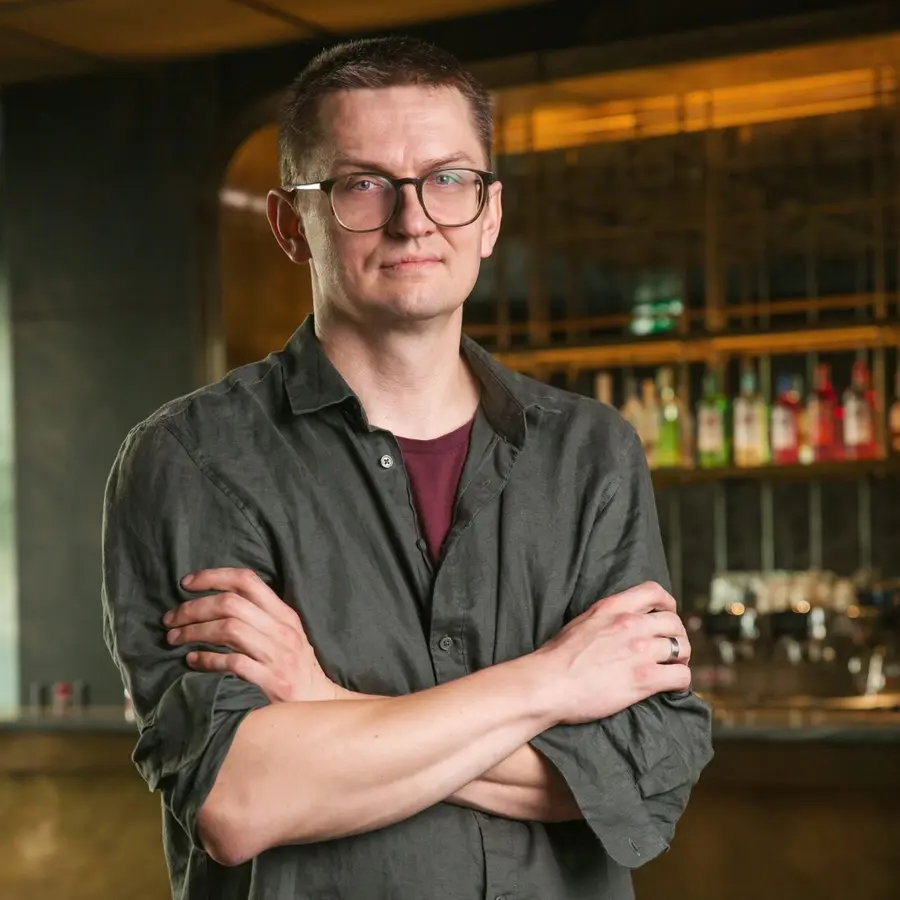
Marcin Litwa - art curator at The Cyrus hotel. We invite you to a short interview with the artist who breathed life into the walls of our hotel.
The art curator of The Cyrus hotel, who does not like to be called an artist, but everyone admires his work in our beautiful interiors. He is a graduate of the Academy of Fine Arts in Wrocław, Faculty of Glass and Ceramics, and the School of Artistic Crafts, where he obtained a master's degree in gilding. His works have been exhibited worldwide.
ACT I "The Purest of Forms"
In the rooms and common areas, tables with characteristic turquoise mosaic catch the eye. What is the story behind this material?
Marcin: This mosaic is an extremely noble Venetian glass imported from the Italian Orsoni workshop, which has a tradition dating back to around 1900. This company is known worldwide. Interestingly, the material we used is leftover from the renovation of the facade of the historic Pokoyhof Passage. We had about twenty-some kilograms of this glass left and decided to give it new life. The inspiration was classic terrazzo, but on a smaller, more decorative scale. Originally, the mosaic was in the form of square tiles, which we cut ourselves into rectangles. Then we arranged the composition manually, piece by piece, maintaining proper proportions and distances adjusted to the size of the tabletop. The arrangement was done by me, my wife, and my friend’s wife.

Your wife is an artist?
Marcin: No, but she has gotten used to working with me.
She must be an amazing woman. Please tell me, what was the effect of your work?
Marcin: We prepared about 230–240 tabletops in total. Assuming about 100 small mosaic pieces per square decimeter, we're talking about thousands of elements. The whole piece is filled with a special terrazzo grout with enhanced durability, usually used on floors. Here, the glass is treated as a kind of aggregate. The edges of the tabletops were finished with brass flat bars, which were soldered, ground, and patinated on-site to give them the appropriate smoothness and noble appearance.
What inspired you to choose exactly this form and material?
Marcin: I've been looking for a motif for a table mosaic for some time, and this was for me the purest form. Glass mosaics are a huge inspiration to me; every time I travel, I see how many of them are in architecture. It's beautiful painting that does not lose its color over thousands of years. Glass does not fade, whereas other pigments do, which of course is somewhat connected to my studies.
And what was the direct inspiration?
Marcin: We were simply looking for material that could be used here. It's hard to point out one thing; I looked at various inspirations on the internet, analyzed, pondered the topic in my mind, and at one point simply came up with a new idea. I thought: "Why not? Let's try." I made the first pieces to see if it made sense and what it entailed, and when it turned out well and was liked, we went further with it. It's a kind of reworking of large terrazzo, which is used in architecture, on a smaller, decorative scale, exactly for tabletops.
ACT II "Form followed function"
Let's talk now about the furniture in the room. The hotel's furnishing is dominated by brass and copper. Why these metals?
Marcin: I got to know brass during my artistic craft studies, and I was immediately captivated; color-wise it's close to gold, yet extremely malleable and easy to work with. It is a semi-precious metal that does not corrode like steel. Additionally, in the hotel context, brass is extremely hygienic; germs on its surface just die.
These materials age well.
Marcin: Exactly. We checked various options, including solid wood or veneer, but brass wins durability-wise. Even if over years discoloration from drinks appears, just sanding the surface and re-patinaing it restores its shine. It was an investment in the future.
You also used unique patination techniques, for example on the shelves under the TVs.
Marcin: Yes, on desks we used copper patinated to brown, while on shelves we applied noble green patina. It's a chemical-thermal process that accelerates what naturally happens to church copper roofs over decades. I relied on available knowledge and my own experience because few people practice this professionally.
ACT III "Line fluidity"
The bar makes an incredible impression. How was it with the ceramic mosaic? Was it your idea from the beginning?
Marcin: A bar within a bar. These were also material searches because there were several other more industrial concepts. Ultimately, the boss chose this route. We made prototypes: fired tiles, matched colors of greens, burgundy, metallic browns, bottle and olive green in various saturations. The first bronze elements we cast ourselves in the workshop; it involves melting bronze at about 950°C, the material flows and must be poured from the crucible into a sand mold. Later, to speed up and for safety, we commissioned a professional company.
And the shape?
Marcin: We wanted to keep a fluidity so that these were not geometric mosaics but more organic, as it enlivened the composition. This mosaic has wavy shapes. Each element was cut precisely at such an angle so that after flipping you could catch this angle. We set this individually so the joints would be as small as possible. These were long hours; one meter of mosaic took about a day to lay. Besides me, only one guy who saw the difference laid it; others didn't have such an eye.
And the ceramic coloring itself? You said you did it yourselves.
Marcin: Yes. For this purpose, we used available low-melting ceramic glazes, transparent with varying color saturation. These glazes provide very interesting depth and metallic hues in shades of brown. In this project, we used white clay body to make the color more vivid and applied it in layers, from 3 to 6. We did it somewhat empirically, looking for shadows, resulting in a very interesting color diversity.

This is very interesting, and what about laying it?
We glued the mosaic onto specially prepared panels. At the end, after mounting, we arranged the continuation of the pattern at the joints of the panels. There is no straight line dividing this mosaic; it looks like one monolith.
ACT IV "Abstract - intuitive composition"
In the rooms hang artworks that attract the eye with their texture. How did it start?
Marcin: At first, we focused on common areas, and in the rooms, the metal sheets hung first because they were faster to produce. Over time, our compositions came, which are more labor and time-consuming. Making one such work for one person takes around a week, maybe more.
You said these works are divided into specific types. What distinguishes them?
Marcin: Yes, we have four kinds. There's the "Brazilian," which gives the most irregular shapes and is the hardest to design and execute, more wild and untamed. There are the "stripes," which we call that colloquially; they are more calming, harmonious. There are also "tiles," more dynamic where more is happening, but the dynamics are within rectangles. And "waves," which are between tiles and Brazilian. It’s worth adding that each of these compositions is absolutely unique.
What technique do you use to achieve the "old" mirror effect?
Marcin: This is our proprietary antiquing technique. We order ground mirrors externally and then recolor and patinate them ourselves. We remove coatings from regular silver mirrors and use silver blackening agents. We apply this patina with special materials. The whole composition is separated by brass rods.
When creating these compositions, do you follow any specific plan, or is it more impulsive?
Marcin: These are abstract compositions dictated by an internal sense of aesthetics. However, in this project, the space for discussion about the overall vision, especially with the investor, proved extremely valuable. I learned that even if I initially have a different concept, it's worth opening up to external suggestions. It's an incredible synergy, without which these interiors would not have such a distinctive character.
